
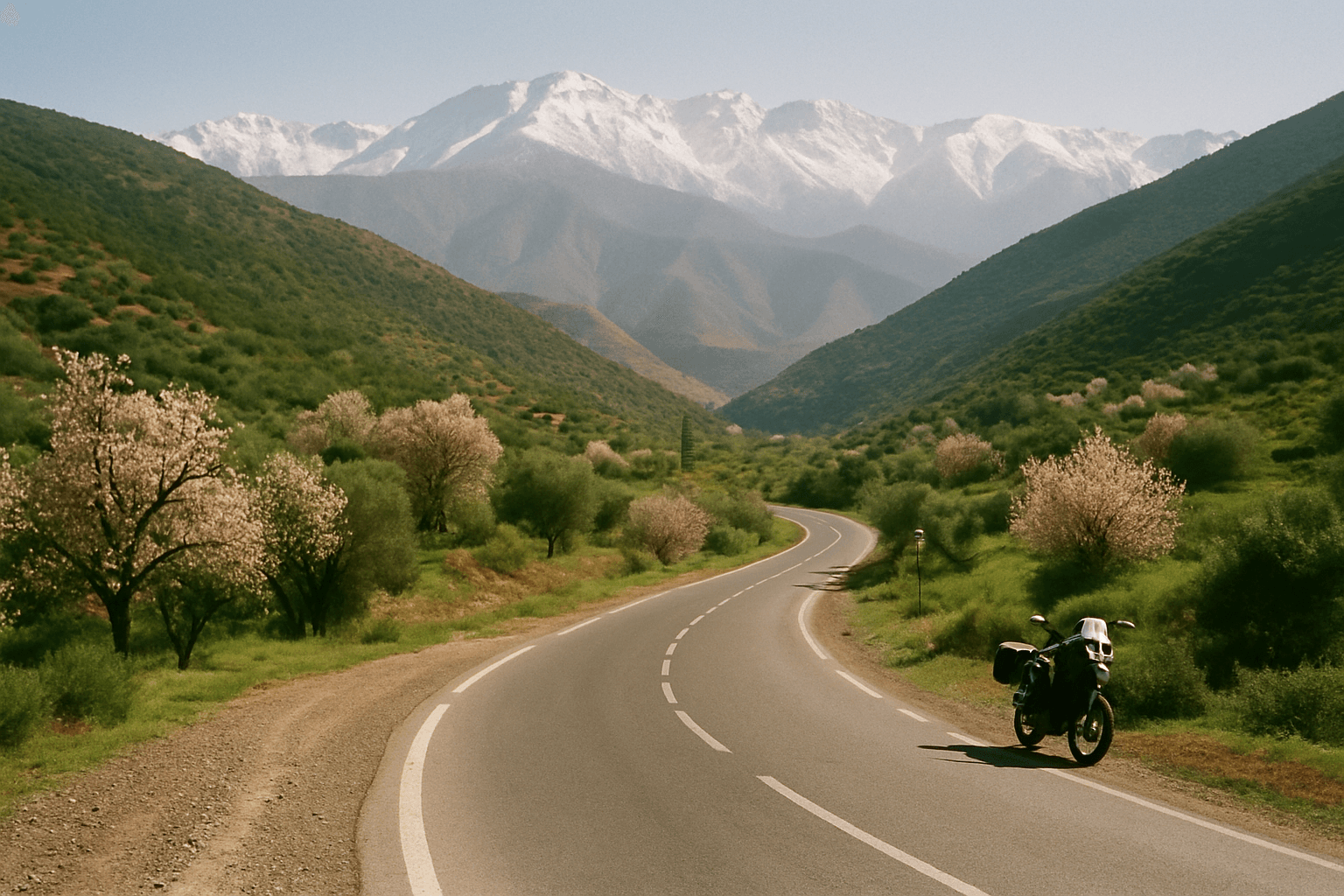
The Best Time for a Motorcycle Tour in Morocco
Morocco has two excellent riding seasons, one that's merely acceptable and one that's genuinely hostile. Getting this right matters more than choosing an operator. The same route in April and in July gives you a great holiday and a survival exercise respectively.
Short version: ride in spring, March to May, or autumn, late September to early November. Here's why, what the exceptions are, and how to salvage a trip on fixed dates. The Morocco motorcycle tours hub has the destination overview.
Morocco is really three climates
Almost every mistake riders make about Moroccan weather comes from treating the country as one place.
- The Atlantic coast. Essaouira, Agadir, Casablanca. Ocean-moderated and consistently cooler than inland. Windy all year. Rideable every month, and your fallback when the interior is unbearable.
- The mountains. The High and Middle Atlas. Cold at altitude, snow-affected from roughly December to February, and 15°C cooler than the plains on the same afternoon. Passes over 2,000 metres can close at short notice in winter.
- The south and the desert. Ouarzazate, the Draa valley, Merzouga. Dry, extreme, the reason summer tours barely exist. Desert highs routinely pass 40°C in July and August. On the same ground a January afternoon is pleasant.
Marrakech, where most tours start, sits between all three. Its average daily maximum runs from about 19°C in January to nearly 38°C in July, and most of the year's modest 220 mm of rain falls between November and April.
Month by month
| Month | Marrakech avg high | Atlas | Desert | Verdict |
|---|---|---|---|---|
| January | 19°C | Snow, possible pass closures | Cool days, cold nights | Coast and desert only |
| February | 21°C | Snow likely on high passes | Warming, very good | Southern routes work |
| March | 24°C | Passes usually open, cold mornings | Excellent | Season opens, very good |
| April | 26°C | Clear, snow-capped peaks, ideal | Excellent | Best month overall |
| May | 29°C | Warm and dry | Hot by month end | Very good |
| June | 34°C | Hot but bearable at altitude | Too hot for comfort | Mountains and coast only |
| July | 38°C | Hot | Dangerous heat in gear | Avoid inland |
| August | 37°C | Hot | Dangerous heat in gear | Avoid inland |
| September | 33°C | Cooling, very good late month | Improving from mid-month | Good from the 20th |
| October | 29°C | Superb | Superb | Best month after April |
| November | 23°C | Cold mornings, first snow late | Very good | Good, winding down |
| December | 20°C | Snow, closures possible | Cool and clear | Coast and desert only |
Temperature and rainfall figures for Marrakech come from the long-run climate record summarised on the Marrakesh climate table.
The two good seasons
Spring: March to May
The best riding of the year. Atlas passes reopen with snow still on the peaks above them, the valleys are green, the desert hasn't turned punishing, and daylight is long enough for a proper day out. April sells out first. The trade-off is unsettled weather early on: March brings rain in the north, cold mornings at altitude and the odd late snowfall on the Tizi n'Test.
Autumn: late September to early November
Nearly as good, and usually quieter. The desert cools through September and by early October the whole country is comfortable. October is stable, dry and warm almost everywhere, with better light for photographs than spring. By mid-November mountain mornings are genuinely cold and the first snow can land on the high passes.
Summer and winter: what still works
June to August
Don't book a desert itinerary. Full protective gear in 40°C-plus, on black tarmac, hours from shade, isn't a hardship to push through. It's a heat-injury risk. The Atlantic still works: the coast between Essaouira and Agadir stays 10 to 15°C cooler than Marrakech, the Anti-Atlas around Tafraoute is bearable, and Paradise Valley is a genuine summer destination. The Sea and Sun coastal weekend is that kind of route.
December to February
Underrated for the south, awkward for the mountains. January desert days are clear, dry and around 19 to 20°C, superb riding weather, with nights close to freezing. Getting there is the problem: the High Atlas passes carry snow and can close without notice, and the alternatives add hours. Winter suits riders who'll accept a route change and pack cold-weather kit.
Which tours run when
Operator calendars follow the weather. Almost every Marrakech-based company concentrates departures in March to May and late September to November, with reduced or coastal-only programmes over the summer.
- Full desert circuits: spring and autumn. Ouarzazate to Merzouga (7 days) and the Agdz to Erg Chegaga run (6 days) are shoulder-season trips by design.
- Mountain and desert combinations: spring and autumn, once the passes are reliably clear. See Desert and Atlas and Moroccan Mountains Adventure.
- Off-road and dune riding: strongly seasonal. Sand at 45°C is a different and worse sport. Sahara Experience and Trails of the Sahara run in the cooler months.
- Coastal and Anti-Atlas routes: the widest window, summer included. Sea and Sun works the Atlantic side, where the sea keeps temperatures survivable when the interior does not.
- City itineraries: the Imperial Tour through Fes, Meknes and Rabat works across a longer season, since the north is milder.
Two planning details people miss
- Ramadan moves. The Islamic calendar shifts roughly eleven days earlier each year, so Ramadan drifts through the seasons. Riding during it is entirely possible and often rewarding, but roadside restaurants may be shut during daylight and towns stay quiet until sunset. Check the dates for your year before booking.
- Altitude does the work, not the calendar. A 25°C afternoon in Marrakech is 10°C on the Tizi n'Tichka. Pack a liner even in April.
Frequently asked questions
What is the single best month to ride in Morocco?
April, with October a close second. April gives you open Atlas passes, snow still visible on the peaks, green valleys and a desert that's warm rather than hostile. October matches it for stability with better light and fewer riders. Both are when the most tours depart.
Can I ride in Morocco in summer?
On the Atlantic coast and in the Anti-Atlas, yes. Inland and in the desert, no. July and August highs in the south routinely exceed 40°C, and full gear turns that into a health risk. If summer is your only option, build a coastal route and start at dawn.
Do Atlas passes close in winter?
They can. Snow affects Tizi n'Tichka and Tizi n'Test between December and February, and closures happen at short notice rather than on a schedule. High piste routes stay impassable longer. Plan a winter alternative route, don't assume one.
Is the desert cold at night?
Very. Clear desert skies radiate heat fast, and a January night near Merzouga can approach freezing after a 20°C afternoon. Even in spring and autumn the swing between midday and midnight is large. That's why experienced riders pack a thermal layer for a trip they think of as hot.
When does it rain in Morocco?
Mostly between November and April, and not much even then. Marrakech averages around 220 mm a year, with the wettest months still under 40 mm. Rain is heavier in the north and on the coast than in the south. The risk isn't getting wet, it's what mountain rain does to river crossings downstream.
Which months are cheapest?
Summer and midwinter. Prices here are less season-sensitive than in Europe because so much of the cost is fixed, but shoulder dates in late November and early March are quieter and easier to book. Full picture in the Morocco motorcycle tour cost guide.
Which route should I pick for my dates?
Spring and autumn open everything, so choose on terrain instead. Our Atlas and Sahara route guide lays out the options. For summer or winter dates, let the season pick: coast in summer, south in winter. Operator strengths are compared in the Morocco tour companies guide.