
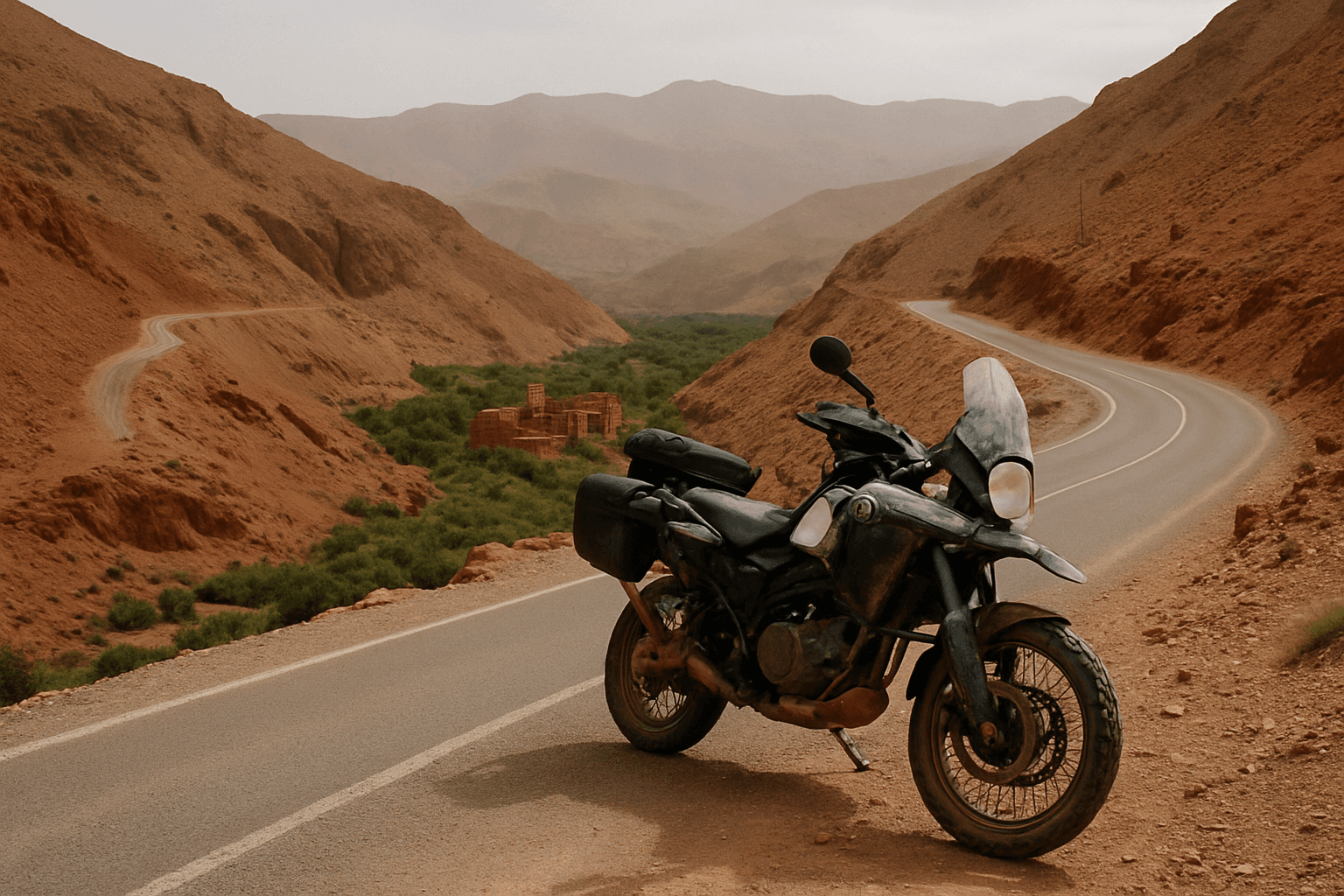
Morocco Motorcycle Routes: Atlas Passes to the Sahara
Morocco's appeal to riders is geographic compression. One country gives you a 2,200-metre alpine pass, a gorge with 300-metre walls, a palm-oasis valley, a stone desert plateau and a real sand sea, and you can ride between all of them inside a week. Nothing else within three hours of Europe does that. The country overview lives on our Morocco motorcycle tours hub.
The routes at a glance
| Route | Road | From / to | High point | Character |
|---|---|---|---|---|
| Tizi n'Tichka | N9 | Marrakech to Ouarzazate | 2,205 m | Wide, rebuilt, busy with trucks |
| Tizi n'Test | R203 | Marrakech to the Souss valley | 2,100 m | Narrow, old, unguarded edges |
| Thousand Kasbahs | N10 | Ouarzazate to Tinghir | Valley floor | Palm groves, kasbahs, easy tarmac |
| Dades gorge | R704 | Boumalne to M'Semrir | Plateau | Stacked hairpins, then piste |
| Todra gorge | Tinghir spur | Tinghir north | 300 m walls | Short, tight, bus traffic |
| Merzouga run | Desert road | Tinghir to Erg Chebbi | Hammada | Flat and fast, sand at the end |
| Draa valley | Draa road | Ouarzazate to M'Hamid | Tizi n'Tinififft | Quiet, remote, ends at sand |
| Anti-Atlas | Tafraoute roads | Agadir loop | Granite country | Empty, well surfaced |
The High Atlas passes
Tizi n'Tichka (N9)
The main artery south from Marrakech to Ouarzazate, and the pass most riders meet first. GPS surveys put the summit at 2,205 m, though the long-quoted 2,260 m still turns up on signs and in guidebooks. Rebuilt over the past decade: wide, well-surfaced, long third- and fourth-gear hairpins through Berber villages and argan scrub.
It carries traffic, including trucks that use the whole road through the corners. Ride it early. On the descent take the old branch through the Ounila valley: slower, narrower, past the crumbling Glaoui kasbah at Telouet and down to the mud-brick ksar at Ait Ben Haddou. Two extra hours, worth every one.
Tizi n'Test (R203)
The harder, older and better one. It crosses the range southwest of Marrakech at about 2,100 metres and was never widened into a highway. Narrow tarmac, blind hairpins, unguarded edges, long stretches where two vehicles can't pass unless one stops. The payoff is the summit view down the Souss valley towards the Anti-Atlas, and the Tin Mal mosque on the northern approach.
Ride the two as a loop out of Marrakech, Tichka south and Test north or the reverse. That's the best paved mountain riding in North Africa, in two days.
The lesser passes
Beyond the big two sit dozens of minor cols: the roads over the Jebel Sarhro towards Nekob, the climb from Imilchil into the Middle Atlas lakes, the Tizi n'Tazazert piste. Traffic disappears entirely up here, and several are unsealed.
The gorges and the Route of a Thousand Kasbahs
South of the mountains the N10 runs east from Ouarzazate through Skoura's palm groves to Boumalne Dades and Tinghir. This is the Route of a Thousand Kasbahs, the connective tissue of nearly every Morocco itinerary.
Dades gorge (R704)
Turn north at Boumalne and the R704 climbs the gorge for around 60 kilometres towards M'Semrir. The famous bit is a set of hairpins folded into red rock. Past them the surface deteriorates and the valley opens onto high plateau. Keep going and you're on piste to Imilchil.
Todra gorge
Thirty kilometres east at Tinghir, a road runs north into a slot where limestone walls close to a few dozen metres apart and rise 300 metres above the tarmac. Short, full of tour buses at midday, still worth riding. Go early. It carries on north onto the plateau, and the loop back to Dades over the tops is a serious unpaved day, not a shortcut.
Desert routes
Merzouga and Erg Chebbi
East of Tinghir the land flattens into hammada, black stone desert, through Erfoud and Rissani to Merzouga, where the Erg Chebbi dunes come up out of nothing. Tarmac runs to the edge of the sand. The erg itself is proper sand technique on a light machine. For most visitors the piste tracks skirting the dunes are the realistic version.
The Draa valley
The other desert road runs southeast from Ouarzazate over the Tizi n'Tinififft to Agdz, then follows the Draa river through palmeraie and kasbahs to Zagora and M'Hamid, where it stops at the sand. Quieter and more remote than the Merzouga run. Zagora to M'Hamid is one of the great empty rides.
Anti-Atlas and Tafraoute
Often skipped, and skipping it is a mistake. Granite country around Tafraoute: pink rock, almond terraces, palm gorges, near-deserted and beautifully surfaced roads. Pair it with the Atlantic coast between Agadir and Essaouira for a route that avoids the desert entirely, useful in hotter months.
Surfaces: what you'll actually ride on
| Surface | Where | Bike that suits it |
|---|---|---|
| Good asphalt | N9, N10, main coastal and imperial-city routes | Anything; a road-biased GS is ideal |
| Narrow mountain tarmac | R203 Tizi n'Test, gorge roads, Anti-Atlas | Mid-weight adventure or road bike |
| Graded piste | Plateau links, Draa side roads, kasbah approaches | Adventure bike on knobbly-ish tyres |
| Rocky trail and oued beds | Jebel Sarhro, Dades-to-Todra plateau crossing | 450 to 690 class enduro |
| Soft sand | Erg Chebbi, Erg Chigaga approaches | Light enduro, with a guide |
Sealed mountain roads collect gravel washed into the outside of bends. Treat every blind corner as though there's a patch waiting.
Navigation and logistics
- Offline maps. Coverage is good on main roads and absent where you most want to be. Download the whole country before you leave.
- Fuel. Stations are frequent on the N9 and N10, sparse beyond Zagora, Rissani and M'Semrir.
- Checkpoints. Police posts outside towns are routine and polite. Keep licence, IDP and bike documents reachable.
- Documents. UK government advice is that you need the 1968 version of the international driving permit alongside your home licence, and that the 1949 permit is out. Your own bike also means a green card from your insurer. See the UK Foreign Office Morocco guidance.
- Daylight. Livestock, unlit carts and poor street lighting make night riding genuinely risky outside cities. Be off the road by dusk.
Plan on 200 kilometres of usable fuel range in the south, even if your bike does more.
Building a route
Five to six days
Marrakech, Tizi n'Tichka, Ait Ben Haddou, Dades, Todra, back over the mountains. Tight but complete, and roughly the shape of High Peaks and Desert and the Moroccan Mountains Adventure Tour.
Eight to nine days
Add Merzouga and the dunes, or trade tarmac for piste. Desert and Atlas (9 days, 2,000 km) is the road version, Trails of the Sahara and Beyond (9 days) covers similar ground mostly off it, and the Extreme South Enduro Raid (8 days) is the hardest of the three.
Eleven days or more
Both halves, plus the imperial cities. Best of Morocco on Motorbike takes fourteen days over the desert and Fes, and is the longest Morocco-based itinerary we list.
Off-road specific
If piste is the point rather than the seasoning, look at Trails of the Sahara and Beyond or Sahara Experience in Morocco. Riding styles are compared in our Morocco tour companies guide.
Frequently asked questions
What is the best motorcycle route in Morocco?
Ride one thing and make it the Tizi n'Tichka south from Marrakech, the Ounila valley detour to Ait Ben Haddou, then east on the N10 to the Dades gorge hairpins. Pass, kasbahs and gorge in two days.
Do I need an off-road bike?
Not for the classic circuit. Every pass, gorge road and desert-edge town above is reachable on tarmac, and a road-biased adventure bike covers it comfortably. Dirt machinery and a guide are for the piste crossings, the erg and the plateau routes between the gorges.
Are the Atlas passes open all year?
Mostly, but not reliably in winter. Snow closes Tizi n'Tichka and Tizi n'Test at short notice between December and February, and the higher pistes stay impassable longer. Spring and autumn dodge the snow and the summer heat both. See the best time to ride in Morocco.
How far can I realistically ride in a day?
Less than the map suggests. Between 200 and 300 kilometres is a full day on mountain and gorge roads once you allow for photo stops, checkpoints, mint tea and the corner where a herd of goats is standing. Tour itineraries average 200 to 250 km per riding day.
Is it safe to ride into the dunes?
Not alone, and not on a heavy bike. Sand riding is a specific technique, the erg has no landmarks, and a fall out of sight of the road in 40°C is serious. Every operator offering dune riding does it with a guide and a support vehicle. That's the minimum.
What about fuel range?
Stations exist beyond Zagora, Rissani and M'Semrir, but you can't rely on them having fuel, being open, or taking a card. Carry cash.
Can I combine Morocco with Spain?
Easily, and some operators build it in, riding down through Andalusia and crossing by ferry from Algeciras or Tarifa. Three or four days each way, and a Morocco trip becomes a two-country tour. Browse Spain motorcycle tours for the northern half.