
The Ha Giang Loop: Complete Motorcycle Tour Guide
The Ha Giang Loop earns the noise made about it. Four days takes you from a river valley onto a limestone plateau and out onto a shelf of tarmac cut into a cliff above a turquoise gorge, through villages where market day is the week's main event. There are prettier roads in Asia and harder ones. Nothing feels like this.
Quick facts
| Item | Detail |
|---|---|
| Loop distance | 300 to 400 km, depending on branches |
| Main road | National Highway 4C (QL4C), the Happiness Road, roughly 185 km |
| Start and finish | Ha Giang city, 300 km north of Hanoi (6 to 7 hours) |
| Riding days | 3 to 5. Four is the sweet spot |
| Surface | Mostly sealed, with broken concrete, gravel and mud in patches |
| Best months | September to November, then March to May |
| Paperwork | Home licence for the engine class, plus a 1968 Convention IDP |
What the loop actually is
The spine of the ride is QL4C, hand-cut through karst mountains between 1959 and 1965, largely by youth volunteer brigades working with hand tools. Ho Chi Minh named it the Happiness Road in 1961, while the work was still going on. It runs about 185 kilometres from Ha Giang city through Quan Ba, Yen Minh, Dong Van and Meo Vac. Ride it out and provincial roads back and the circuit comes to 300 or 400 kilometres.
Ha Giang city is six to seven hours north of Hanoi by road, so nearly every tour builds in an overnight bus or a transfer day at each end. Wider country picture: our Vietnam motorcycle tours hub.
The route, section by section
| Stage | Road | What you get |
|---|---|---|
| Ha Giang to Quan Ba | QL4C, about 45 km | Terraces, Heaven's Gate, Twin Mountains |
| Quan Ba to Yen Minh | QL4C | Pine forest, the usual first night |
| Yen Minh to Dong Van | QL4C | Karst plateau, Tham Ma switchbacks, Lung Cu |
| Dong Van to Meo Vac | QL4C, 20 km | Ma Pi Leng Pass above the Nho Que river |
| Meo Vac to Ha Giang | Direct, or via Du Gia | Waterfalls, river crossings, rough surfaces |
Ha Giang to Quan Ba
The warm-up, and a good one. The road climbs out of the valley through tea and maize terraces to Quan Ba Heaven's Gate, with its viewpoint over the Twin Mountains. Best surface on the loop, so use it to learn the bike.
Quan Ba to Yen Minh
Rolling forest and pine, long open corners, much less traffic. Most three-day itineraries stop the night in Yen Minh. Not the most dramatic stretch, but it's where the ride starts to feel like a journey.
Yen Minh to Dong Van
Here the geology takes over. You're on the Dong Van Karst Plateau, a UNESCO Global Geopark since 2010, and grey limestone teeth push out of every hillside. The switchback ladder at the Tham Ma slope is the photograph everyone takes. The Hmong King's palace at Sa Phin and the flag tower at Lung Cu, Vietnam's northernmost point, are the usual detours. Dong Van's old quarter is the best overnight on the loop.
Dong Van to Meo Vac: the Ma Pi Leng Pass
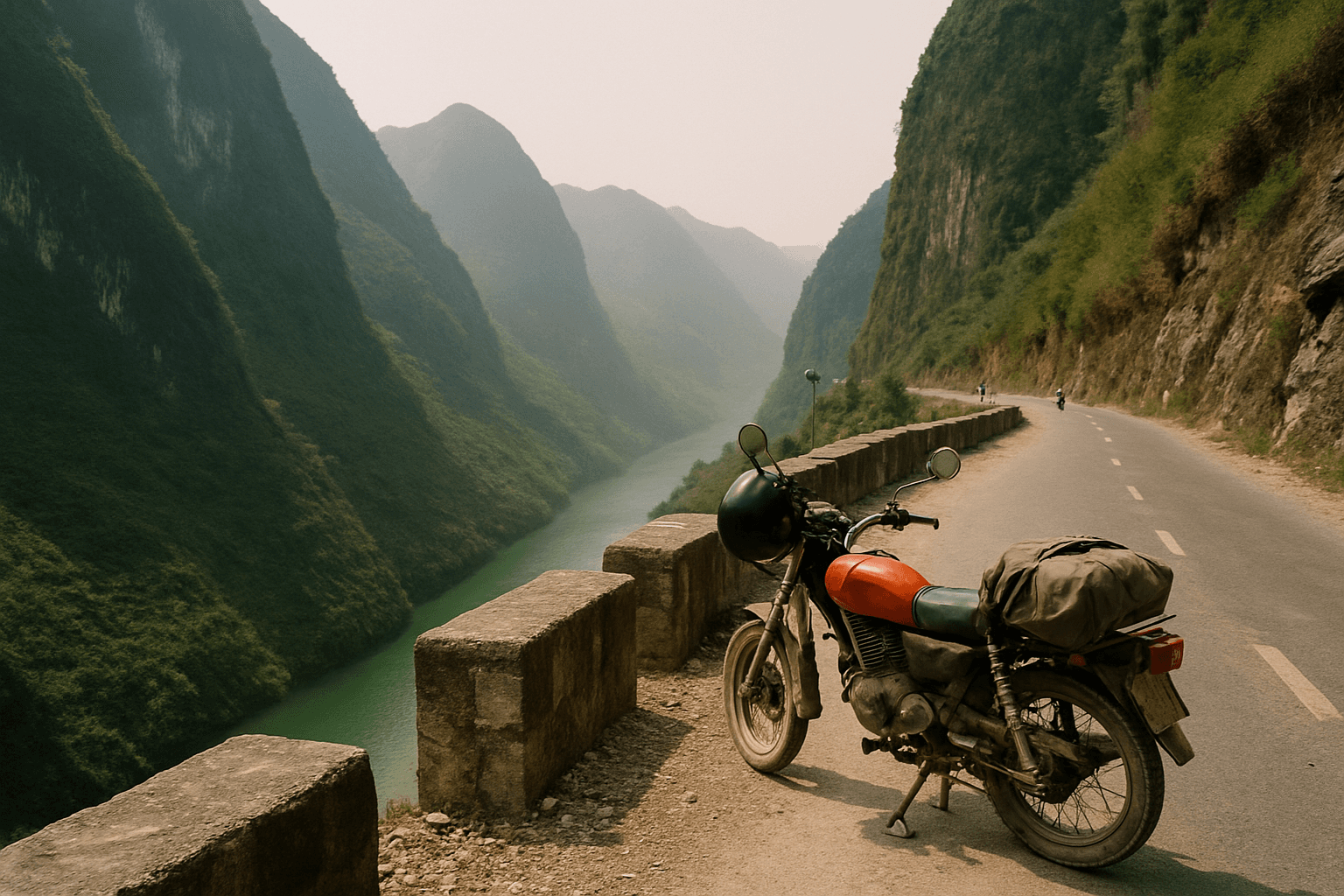
Twenty kilometres carved into a cliff face above the Nho Que river and the Tu San canyon, with a monument at the top to the volunteers who built it. This is the section that sells the loop. The drop on one side is vertical, the rock on the other overhangs the road, and the river below is an improbable jade. Ride it slowly. Boat trips into the canyon leave from a road off the pass and are worth the hour.
Meo Vac back to Ha Giang
This is where itineraries diverge. Straight back through Yen Minh is quick. Longer versions swing south through Mau Due and Du Gia: rougher, quieter, more river crossings and small waterfalls. That's the stretch people talk about back home.
Three days, four days or five?
| Length | Typical shape | Suits | Trade-off |
|---|---|---|---|
| 3 days | Yen Minh, Dong Van, Meo Vac, back | Tight schedules, confident riders | Long days, no Du Gia |
| 4 days | Adds Lung Cu or Du Gia and a half rest day | Most riders | The best balance available |
| 5 days | Adds Hanoi transfers, or a full Du Gia loop | First-timers flying via Hanoi | Two days travelling, not riding |
Four riding days is the honest answer. Three works, but it squeezes Ma Pi Leng into an afternoon when you're already tired. Five is usually four riding days with the Hanoi transfers counted in, which is how the five-day Ha Giang Loop tour from Hanoi is built. I'd take that if your time is tight.
Self-ride, easy rider, or fully guided
Riding it yourself
Rent a bike in Ha Giang city, put a route on your phone, go. Cheap, flexible, and plenty of people do it. The catch is that everything becomes your problem: a flat tyre on the Ma Pi Leng, a landslide closing the road to Du Gia, a crash where your insurance turns out not to apply. Go solo only if steep, loose village concrete doesn't worry you.
Easy rider
You sit behind a local rider and he does the riding. Vietnam has a long tradition of it, and the original easy riders built the model in Dalat. You can still sample that on the Dalat countryside day tour for very little money. On Ha Giang it's the standard option for non-riders and anyone who'd rather watch the gorge than the road surface. I don't think it's a lesser experience. Just a different one.
Guided group tour
Guide at the front, mechanic at the back, beds and meals arranged, and a support vehicle on the better-run trips. That kills the two things that actually ruin Ha Giang trips: mechanical failure a long way from anywhere, and weather forcing a route change you don't know how to make. Guides also get you homestays and market-day timing you can't arrange from outside.
Telling good operators from resellers: our Vietnam motorcycle tour companies guide.
The licence reality
Riders get this wrong more than anything else, and it costs more than a checkpoint fine.
The full position, including how longer-stay riders convert to a Vietnamese licence, is in Vietnam motorcycle licence and IDP requirements. Read it before you book, not at the rental counter.
When to go
September to November is the best window. Summer rain has stopped, the rice terraces are golden, and visibility on the passes is at its best. March to May is second choice: warmer, greener, buckwheat and fruit blossom around Dong Van.
June to August is the rainy season. Not unrideable, but the roads slide, the passes fill with cloud, and river crossings on the southern branches can close. December to February is dry and properly cold at altitude, with fog and occasional frost up high. Go then and take real thermal layers, because rental gear won't be enough.
Regional timing is compared in Thailand vs Vietnam.
What bike
Small and light wins here, no exceptions. The Honda XR150L is the default and deserves it: enough power for the climbs, light enough to pick up, and every mechanic in northern Vietnam knows it. Honda CRF250L and CRF300L Rally machines turn up on dual-sport tours and are better again if you can ride one properly. Semi-automatic 110cc scooters are what a lot of independent travellers end up on. They'll finish the loop, but they work hard on the steep sections and the brakes are the weak point.
Large adventure bikes are the wrong answer. Village roads are narrow, surfaces change without warning, and 220 kilos on wet concrete at a 20% gradient is no fun.
On the Happiness Road, the right bike is the one you can pick up on your own.
Safety and road conditions
- Surfaces change within a kilometre. Asphalt gives way to broken concrete, gravel and mud.
- Landslides are routine after rain. Rock on the road is normal. Local drivers know where. You don't.
- Livestock and children. Villages sit on the road. Buffalo don't check for traffic.
- Trucks on blind corners. Assume something wide is coming and keep left of centre.
- Alcohol. Homestay dinners come with rice wine and real social pressure. Agree the rules on night one.
- Medical distance. The nearest serious hospital to the Ma Pi Leng is hours away. Insurance that names motorcycling isn't optional.
Guided Ha Giang and northern Vietnam options
- Ha Giang Loop Motorbike Tour from Hanoi, 5 days, from $140, bike, guide, fuel, meals and accommodation included. Run by Vietnam Motorbike Tour Expert on Honda XR150L, CRF250L and CRF300L.
- Northern Dual Sport Vietnam Tour with Guide and Support Truck, 14 days and roughly 2,120 km. Ha Giang, Dong Van and Meo Vac sit inside a much bigger northern circuit, support vehicle and mechanic included. From RIDE Adventures.
- Ho Chi Minh Trail Motorcycle Tour, 12 days, if you'd rather ride the length of the country.
Frequently asked questions
How long does the Ha Giang Loop take?
Three to five days of riding. Four is the sweet spot: an unhurried run at Ma Pi Leng and room for the Du Gia branch. Add a day at each end for Hanoi, because that transfer is six to seven hours by road each way.
Is the Ha Giang Loop dangerous?
It asks for respect rather than expertise. The road is sealed for most of its length and the corners aren't hard, but the drops are unguarded, the surface changes constantly and other traffic is unpredictable. The riders who come unstuck turned up with no recent experience, on a scooter they'd never used, going faster than their sightlines allowed.
Can I ride it without a motorcycle licence?
You shouldn't. Vietnam expects a valid home licence covering the bike class plus a 1968 Convention IDP, and the practical consequence of riding without them is that your insurance doesn't respond after a crash. No licence? Take an easy-rider seat behind a local guide.
What is the best month for Ha Giang?
October, for my money. The rain has finished, the terraces are being harvested, and the air is clear enough to see across the Nho Que gorge. September and November run it close. March to May is the alternative window.
Do I need to book a tour, or can I organise it locally?
Both work. Ha Giang city is full of rental shops and hostels selling loop packages, and prices are low. Booking ahead buys a known bike, a known guide and a written inclusions list, which matters more here than on an easy route.
Can I do the loop on a scooter?
Physically yes, and thousands do. But an automatic has weaker brakes and less engine braking than a geared bike, and the descents off Ma Pi Leng and around Du Gia are long. If you're not already confident on a semi-automatic, pay the small extra for an XR150L and a guide.
What should I pack?
Proper gloves, an armoured jacket, boots over the ankle, and waterproofs whatever the season, because mountain weather at 1,500 metres does what it likes. Bring more warm layers than you think you need for October to March. A power bank too: you'll navigate by phone, and homestay electricity isn't guaranteed all night.