
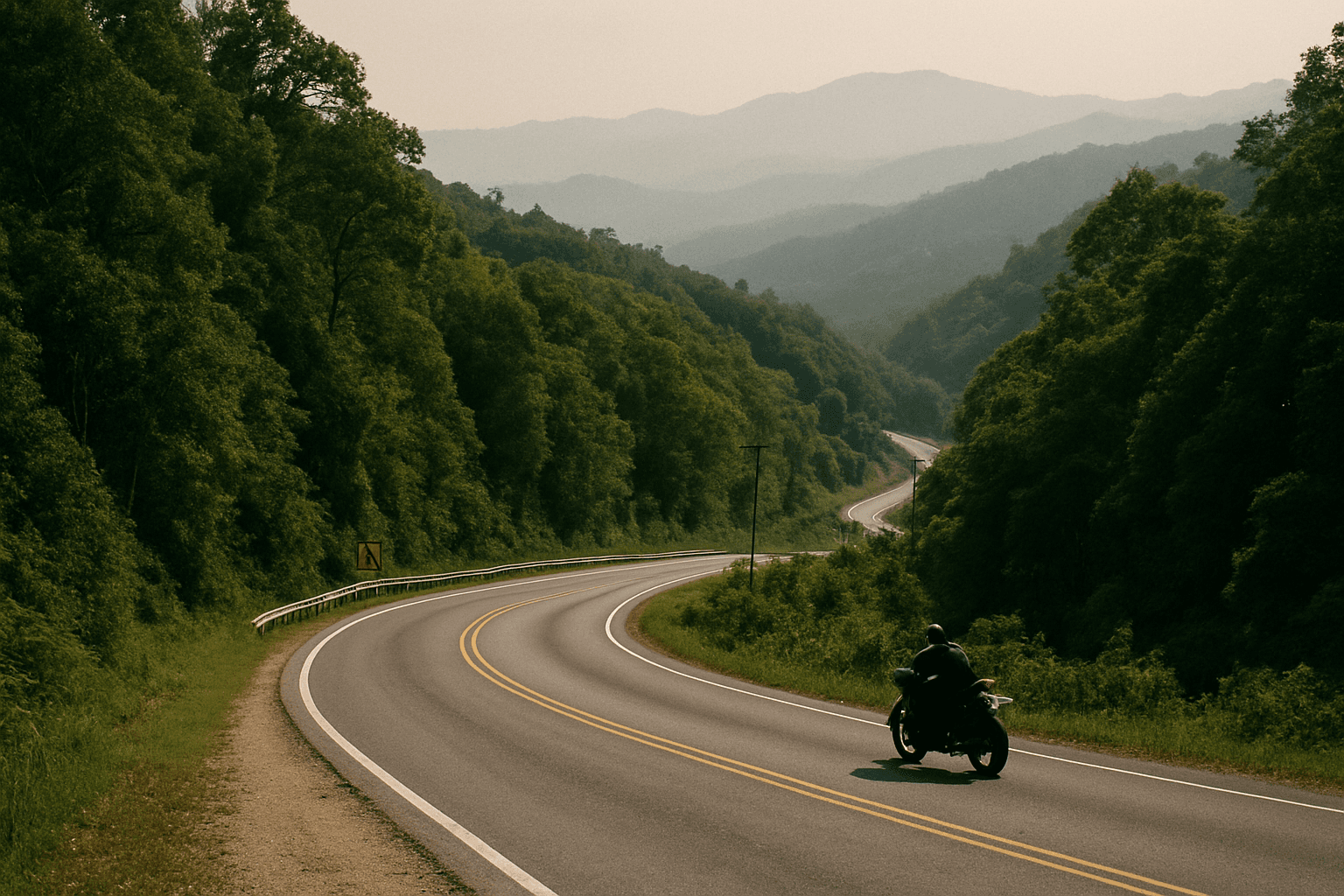
The Samoeng Loop: Chiang Mai's Perfect Half-Day Motorcycle Ride
Every riding region has a warm-up road, and northern Thailand's is the Samoeng Loop. Roughly 100 kilometres in a circle northwest of Chiang Mai: out of the city into the Mae Sa Valley, up through flower farms to a viewpoint over folded green hills, down into a market town almost nobody stops in, and back at your hotel for a late lunch. Sealed throughout, doable on a rented scooter, and the best half day of riding available from a northern Thai city without booking anything.
It also tells you if the bigger trips are for you. Plenty of people ride Samoeng on a Tuesday and book the Mae Hong Son Loop on the Wednesday. Wider country context: our Thailand motorcycle tours hub.
Quick facts
| Detail | What to expect |
|---|---|
| Distance | Around 100 km, start and finish in Chiang Mai |
| Roads | 107 and 1096 out via Mae Rim, 1269 back via Hang Dong |
| Seat time | About 3 hours moving |
| Realistic day | 4 to 5 hours with stops, 8 to 9 if you sightsee properly |
| Climbing | Roughly 1,500 m cumulative, from about 300 m to over 1,100 m |
| Surface | Sealed two-lane throughout, gradients rarely above 8% |
| Fuel | Fill up on 107. No reliable pump between Pong Yang and Samoeng |
| Best season | November to February |
| Start by | 08:00 to 08:30 |
The route, section by section
Chiang Mai to Mae Rim (Route 107)
The dull bit, and the only genuinely unpleasant traffic of the day. Sixteen kilometres of four-lane highway north out of the old city, shared with pickups and songthaews. Fill the tank before you turn off. Fuel gets scarcer and dearer once you leave 107.
Mae Sa Valley (Route 1096)
The road narrows, the temperature drops a couple of degrees, and the corners begin. The commercial stretch: orchid nurseries, waterfall car parks and elephant camps along the first twenty kilometres. Broad, forgiving bends, third gear stuff that lets you settle into the bike. Mae Sa Waterfall and the Queen Sirikit Botanic Garden, a thousand-hectare site with a canopy walkway, are each worth an hour. The waterfall stops admitting visitors in the late afternoon, an argument for taking this end first.
Pong Yang, Pong Khrai and Mon Cham
Past the tourist strip the road gets serious about climbing. Switchbacks stack up through Pong Yang and Pong Khrai, the resorts thin out, the air cools. The turn-off for Mon Cham (Mon Jam on some signs) is the high point of most people's day: a short, steep, part-gravel access road up to terraced flower and strawberry fields on an open ridge. Parking is informal and sloped, so leave the bike nose-downhill in gear. Get there before mid-morning, because tour buses start arriving around eleven and the access road isn't wide enough to argue with one.
Samoeng and the forest viewpoint
After Mon Cham the road empties out and becomes the best riding of the loop: narrower, quieter, tree-shaded, with a rhythm the lower valley never had. The Samoeng Forest Viewpoint is a free roadside pullout at around 1,120 metres. Samoeng town sits slightly off the circuit and is a working market town rather than an attraction, which is why it's a good stop for noodles.
Samoeng to Hang Dong (Route 1269)
The technical section, and the reason this loop is more than a scenic drive. Route 1269 runs southeast through forest with steep switchbacks around Ban Mae Khanin that demand deliberate lines and early braking. In the dry it's superb. After rain, or late when the light goes flat under the trees, gravel and leaf litter punish anyone riding the front brake. Once the hills release you into Hang Dong it's flat and quick into the city, Wat Phra That Doi Kham above as the traditional last stop.
Clockwise or anticlockwise?
This is the one genuine argument about the loop, and riders you trust will tell you opposite things.
Anticlockwise means north out of the city on 107, up the Mae Sa Valley, back through Hang Dong. It's what most people do and what most route notes describe. The waterfall and botanic garden land early enough to actually visit, you reach Mon Cham before the buses, and the tighter 1269 waits until you've had three hours on the bike.
Clockwise means south on 108 and out through Hang Dong first. Real case for it: you hit the hard hill section freshest and reach the quiet forest before anyone else. The trade-off is that the attractions land late and you ride the busy 107 approach at the end of the day.
My advice: anticlockwise the first time, clockwise the second.
When to ride it
November to February is the window, for the same reasons it's the window everywhere in the north: dry roads, clear air, mornings cool enough to want a jacket liner on the ridges. Late February through April, agricultural burning fills the valleys with smoke, and a viewpoint ride is a poor choice when you can't see past the next ridge. June to October is monsoon: green hills, quiet roads, afternoon rain. Our month-by-month Thailand riding calendar has the detail.
What to ride, and the rental reality
Almost anything works. A 125cc automatic, the Honda Click and its rivals at a few hundred baht a day, will complete the loop without drama. Two-up, step up to a PCX 160 or an NMAX: the extra engine braking matters more on the descents than the extra power does anywhere. A geared bike is better again, same reason. For big-bike riders the CB500X is the standard Chiang Mai rental at roughly 1,200 to 2,000 baht a day. More bike than the loop needs, and a lovely way to ride it.
Two things the rental shop may not volunteer:
- Never hand over your passport. Reputable shops take a photocopy and a cash deposit. A shop demanding the original is telling you how it settles disputes.
- Check the brakes and tyres yourself, before you leave the forecourt. Route 1269 does not forgive a soft lever or a squared-off rear.
Licence and safety
Carry your home motorcycle licence and a 1968-version International Driving Permit. UK government guidance for Thailand is explicit: you need the 1968 permit alongside your own licence, helmets are a legal requirement, and riding without a valid licence can invalidate your travel insurance. That last part is where the money is, because a claim after an accident is where the paperwork gets read. Your licence also has to cover the capacity you ride. Current advice: the UK Foreign Office Thailand page.
Thailand also rides on the left, and the old habit resurfaces at junctions and petrol station exits rather than on the open road. Traffic on 107 is the real hazard of the day, not the mountains.
Riding it guided
This is the classic self-ride day, but there's a case for handing it over on day one: a bike you haven't had to inspect, and a first go at Thai traffic with a wheel to follow. No operator on Moto Mass currently sells the Samoeng Loop on its own, so the choice is a rental with this route in your pocket, or a guided trip that starts on roads like these and keeps going. Let's Ride run a three-day Mae Hong Son tour from Chiang Mai, and a three-day enduro tour through Chiang Dao and Pai if you'd rather be on dirt.
Who runs what: our Thailand motorcycle tour companies guide. Budgeting: what a Thailand motorcycle tour costs.
Frequently asked questions
How long does the Samoeng Loop take?
About three hours of riding. Add an hour or two of stops and you have a comfortable half day. Commit to the waterfall, the botanic garden and a long lunch at Mon Cham and it fills eight or nine.
Can I ride the Samoeng Loop on a scooter?
Yes, and most people do. The loop is sealed throughout and the gradients are moderate, so a 125cc automatic manages fine. The caution is engine braking: automatics have very little, and the descents from Mon Cham and Ban Mae Khanin are long enough to cook a rear brake if you drag it. A 150cc to 160cc scooter or a small geared bike is the better tool for the same money.
Which direction is best?
Anticlockwise, out through Mae Rim, is the standard and the better first attempt. Sights early, buses beaten to Mon Cham, tightest road tackled once you've warmed up. Clockwise is the connoisseur's version: quiet forest first, wide corners home. Neither is wrong.
Is the Samoeng Loop suitable for beginners?
It's one of the friendliest mountain loops in Thailand: sealed, well surfaced, no hairpins demanding real technique, never far from help. It isn't a first-ever ride, though. Be comfortable holding a line through a blind bend and braking on a downhill gradient before you start.
Do I need a licence and an IDP?
Yes. Carry your home motorcycle licence, covering the capacity you're on, plus a 1968-version International Driving Permit. Helmets are a legal requirement for rider and passenger. The real consequence of riding without the paperwork isn't the checkpoint fine. It's that your travel insurance may not pay out.
What should I take with me?
Full-face helmet, gloves, sleeves, water, and cash for the smaller cafes. Fill the tank on Route 107. Add a light waterproof from June to October and a warm layer from November to February, because a 1,100-metre ridge at nine in the morning is a different climate from the old city.