
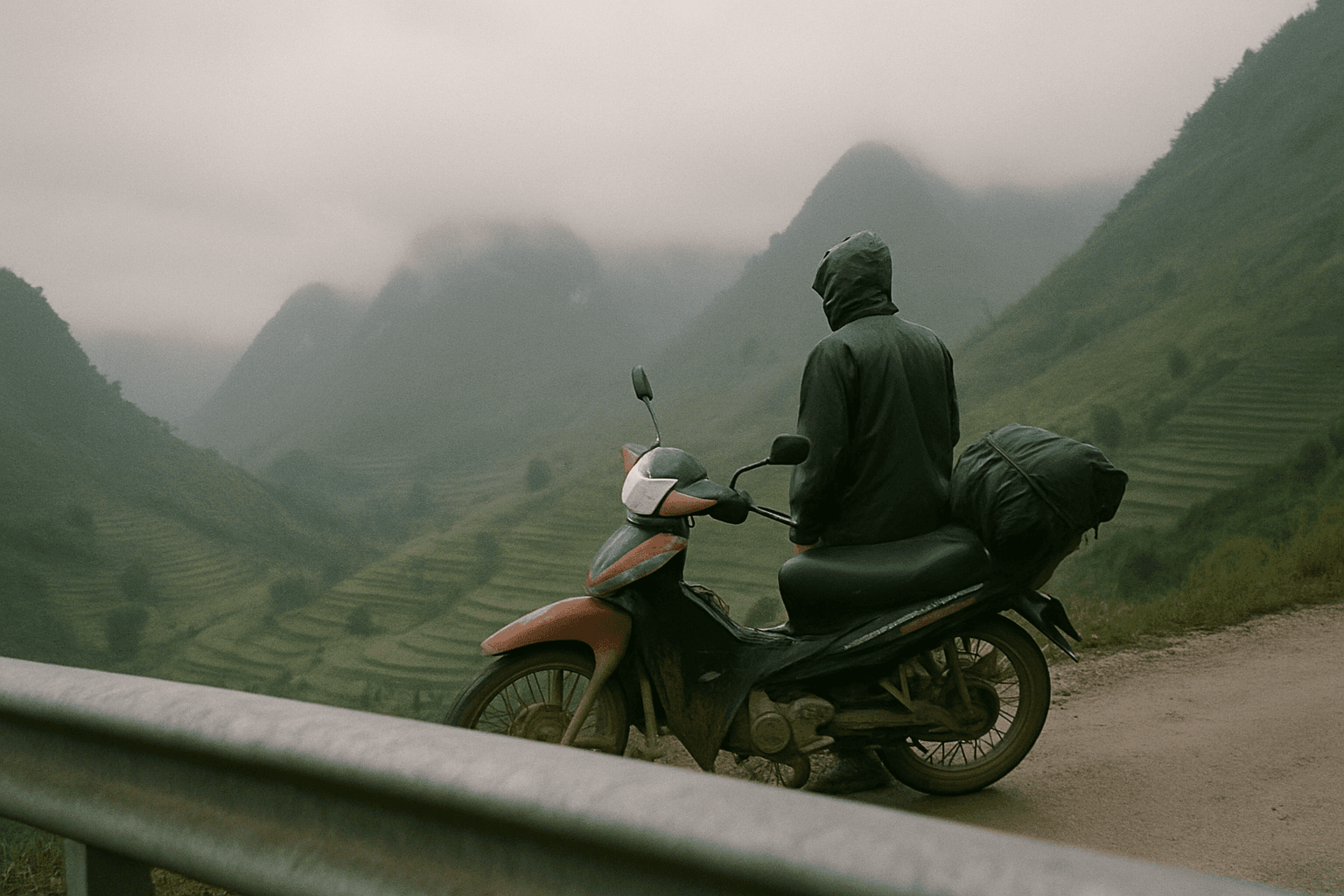
The Best Time for a Motorcycle Tour in Vietnam
There is no single best month to ride Vietnam. The country is about 1,650 km long and its regions run on different calendars. When Hanoi is dry and cool in December, Hue is usually in the wettest stretch of its year. When the far north is soaking in July, the central coast around Hoi An is mostly dry and hot. So the useful question isn't "when should I go to Vietnam?" It's "which part of Vietnam do I want to ride, and when is that part at its best?"
This guide splits the country into four riding regions, gives you real climate figures for each, and flags the things that actually change a motorbike trip: typhoons, landslides, cold fog on the high passes, harvest seasons and the Tet holiday.
The short answer
- Far north (Ha Giang, Sapa, Cao Bang): late September to November is the strongest window. March to April is a good second choice.
- Central coast (Hue, Hai Van Pass, Hoi An): February to August. Avoid October and November if you can.
- Central highlands (Dalat and around): December to March for dry roads. The rest of the year is rideable with rain gear.
- South (Saigon, Mekong Delta): December to April. The wet season brings short, heavy afternoon storms rather than all-day rain.
If you want one window that works reasonably well for a long ride through several regions, March and April are the usual compromise. More on that below.
Month by month, region by region
A planning aid, not a forecast. Seasons shift by a few weeks from year to year.
| Month | Far north mountains | Central coast | Central highlands | South |
|---|---|---|---|---|
| January | Dry but cold. Fog and possible frost on high passes | Cool, drizzly, improving | Dry, cool nights | Dry, hot |
| February | Cold, damp, drizzle. Tet crowds | Mostly dry, mild | Driest stretch | Dry, hot |
| March | Warming, still misty some days | Dry, mild. Good riding | Dry | Dry, very hot |
| April | Warm, clearer. Good riding | Dry, getting hot | First showers | Hottest month, humid |
| May | Rains start, hot in valleys. Terraces flooding | Hot, mostly dry | Wet season begins | Wet season begins |
| June | Wet, hot, landslide risk rising | Very hot, mostly dry | Wet | Afternoon storms |
| July | Peak rain. Worst month for mountain roads | Very hot, mostly dry | Wet | Afternoon storms |
| August | Very wet, landslide risk high | Hot, rain building late | Wet | Afternoon storms |
| September | Rain easing late in month. Rice turning gold | Rains and storm season start | Wettest month | Wet |
| October | Dry, clear, mild. Strong month | Peak rain and flood risk | Wet, easing late | Wet, easing |
| November | Dry, cooler. Buckwheat flowers | Heavy rain, floods possible | Drying out | Drying out |
| December | Dry, cold mornings | Still wet, cool | Dry | Dry, pleasant |
Northern Vietnam: Hanoi, Ha Giang, Sapa
The north has real seasons. Summer is hot and wet, and winter is properly cold once you climb. That matters on a motorbike, because you'll spend most of a northern trip in the mountains, not in Hanoi.
The numbers
In Hanoi, long-term averages put January highs around 20°C and lows around 14°C, with only about 20 mm of rain in each of December, January and February. August is the wettest month at roughly 270 mm. Ha Giang town, the start of the Loop, is wetter: its climate table, based on Vietnam Institute for Building Science and Technology data, shows about 545 mm in July and 430 mm in June, against roughly 40 mm in each of December, January and February.
Keep in mind that Ha Giang town sits low in a river valley. The plateau around Dong Van and the passes above it are a lot higher, and they're noticeably colder and foggier than the town figures suggest. The same goes for Sapa, which sits at roughly 1,500 m and sees freezing temperatures in some winters.
Autumn: late September to November
This is the north's best riding season for most people. The monsoon tails off through September, roads dry out, skies clear, and daytime temperatures in the mountains are comfortable for riding gear. October is often the pick: dry, clear and mild.
It's also when the landscape is at its most photographed. Rice terraces at Mu Cang Chai and Hoang Su Phi turn gold before harvest, usually from mid or late September into early October. Higher fields are cut later than lower ones, so the timing moves around. Then buckwheat flowers come out on the Ha Giang plateau, roughly from October through November, with white blooms early and pink later. Ha Giang has held a buckwheat flower festival in Dong Van in November in recent years, though the dates change each year.
The catch is crowds. The Ha Giang Loop is far busier than it was a few years ago, and October and November weekends see big group convoys on the famous passes. If you can, ride midweek and start early. Our Ha Giang Loop motorcycle tour guide covers the route itself, and the free Heaven's Gate day ride is a short self-guided loop near Ha Giang town if you want a feel for the roads before committing to the full Loop.
One admin note: in 2025 Vietnam merged many provinces, and Ha Giang province became part of Tuyen Quang. The roads and village names haven't changed, but you may see "Tuyen Quang" on newer maps and signs.
Winter: December to February
Winter is dry, which is good, but it's cold, which surprises a lot of riders. At altitude you can get fog thick enough to cut visibility to a few metres, and in cold snaps frost and occasionally ice form on high passes. Vietnamese news outlets regularly report frost on the northern mountains during cold spells, and in January 2016 ice and snow covered stretches of the road over the O Quy Ho Pass near Sapa.
Riding the north in winter is entirely possible. You just need proper layers, winter gloves and a plan that allows a slow day if fog sits on a pass. Fog is usually worst early and often lifts by late morning. Late January and February can also bring a fine, persistent drizzle that leaves limestone roads slick.
Spring: March to April
Spring is a good second window. It warms up fast, the drizzle thins out, and April is often clear and pleasant. You miss the harvest colours but also the autumn crowds.
Summer: May to early September
This is the rainy season, and it's the riskiest time to ride the northern mountains. Heavy rain triggers landslides that close roads, sometimes for hours, sometimes for days. Rivers rise, and dirt sections turn to mud. It's also hot in the valleys.
There is one reason riders still go: water season. From around May into June, farmers flood the terraces at Mu Cang Chai and Hoang Su Phi before planting, and the fields reflect the sky. Vietnam's tourism board puts the flooding in spring and early summer, though exact weeks vary by valley and by altitude. If you go then, go early in the season and keep your plan flexible.
Central coast: Hue, Hai Van Pass, Hoi An
The central coast runs on a different clock from the rest of the country. Most of its rain comes late in the year, when the northeast monsoon pushes moisture off the sea and onto the mountains behind the coast.
Hue's figures make this obvious. According to Hue's long-term climate averages, October gets about 770 mm of rain and November about 640 mm. Compare that with roughly 50 mm in March and 60 mm in April. Around 70% of Hue's annual rain falls between September and December.
The same months overlap with the most active period for typhoons and tropical storms on this stretch of coast. Not every year brings a direct hit, but floods in Hue, Hoi An and the surrounding provinces are common in October and November, and landslides close mountain roads inland. The Hai Van Pass is a great ride in clear weather and a grim one in sideways rain and cloud.
When to ride the central coast
- February to April: the best balance. Mostly dry, temperatures in the mid to high 20s, good visibility on the Hai Van Pass.
- May to August: dry and very hot. Hue's average highs are around 34 to 35°C in June and July. Ride early, rest at midday.
- September to December: wet, with storm and flood risk. Plan around it if you can.
- January: cool, often drizzly, improving through the month.
Central highlands: Dalat and around
Dalat sits at around 1,500 m, so it never gets properly hot. Average highs stay in the low to mid 20s all year, and nights drop to around 12°C in January. That makes it one of the most comfortable places in Vietnam to ride.
The highlands follow the southern pattern for rain. Dalat's long-term averages show about 9 mm in January and 20 mm in February, against roughly 280 mm in September, its wettest month. The wet season runs roughly May to October. Rain in the highlands often comes as afternoon downpours rather than all-day grey, but red dirt and steep hairpins get slippery fast.
Best window: December to March for dry roads and clear views. April and November are good shoulders. If you're in town for a day or two, the free Dalat, Langbiang and Elephant Falls loop is an easy self-guided ride from the city with coffee farms and waterfall stops.
The south: Saigon and the Mekong Delta
The south is tropical and hot year round. There's no cold season, just dry and wet. The dry season runs roughly December to April, with February and March the driest. April is usually the hottest month and can feel brutal on a bike in the middle of the day.
The wet season, roughly May to November, is less of a problem than it sounds. Rain in the south tends to arrive as a hard afternoon storm that lasts an hour or two, then clears. You can plan around that by riding mornings. Expect some flooded lanes in the delta late in the season.
Tet: the holiday that changes everything
Tet, the Lunar New Year, is Vietnam's biggest holiday. In 2027, the first day of Tet falls on Saturday 6 February. Vietnam's culture ministry has backed a seven-day public holiday from 4 to 10 February 2027, though the final schedule is set by the government, so confirm it closer to the date.
Here's what Tet means for a motorbike trip:
- Transport fills up. In the days before Tet, millions of people travel home. Buses, trains and flights sell out and prices rise. If you're shipping a bike by train or bus, book well ahead or avoid those days.
- Things close. For the first few days of the new year, many shops, mechanics, local restaurants and some guesthouses shut. In cities this is very noticeable. Tourist hubs stay more open than small towns.
- Roads get busy, then quiet. Highways are packed just before and just after Tet. During the holiday itself, city streets can be strangely empty.
- The north is cold. Tet lands in the middle of the northern winter, so add the fog and drizzle notes above.
Tet isn't a reason to cancel. The north fills with peach and plum blossom around this time, and people are generally in a festive mood. But don't plan a tight itinerary or count on finding a mechanic in a small town on the first day of the year.
Linking regions on a long ride
A lot of riders want to do the length of the country, often on the Ho Chi Minh Road or a mix of mountain routes and coast. That takes weeks, and it means you'll pass through regions in different seasons. A few rules of thumb:
- March and April are the closest thing to a whole-country window. The north is warming and mostly dry, the central coast is dry, and the south is still in its dry season, though hot.
- Riding north to south from October puts you in the north at its best, but you'll reach the central coast in its worst weeks. If you start in late October, consider moving fast through the centre or waiting it out.
- Riding south to north from January or February gives you a dry south and a dry centre, then a cool, misty north in March. That's a reasonable trade.
- Avoid planning a long trip for July to August unless you're comfortable with rain and real landslide delays in the north.
For a side by side with the neighbouring country, see Thailand vs Vietnam: the best time to ride.
Before you book
Weather is only one part of planning. Make sure your paperwork is sorted: our guide to the Vietnam motorcycle licence and IDP requirement explains what you need to ride legally, which matters for your insurance as much as for police checks.
If you'd rather ride with a guide or join a group, our overview of how to choose a Vietnam motorcycle tour company covers what to ask about bikes, support and rain plans. You can browse small local operators on our Vietnam motorcycle tours page. Listings are free, and we don't rank or promote individual operators. Ask any operator what they do when a storm or landslide closes the route, because in the wet months it will happen.
If you prefer to ride on your own, all our self-guided day rides are free on the routes page, and you can download the GPX for each one.
Pick the region first, then the month
Vietnam rewards riders who plan by region. Pick the part of the country you most want to ride. Then pick the month that suits it: autumn or spring for the far north, late winter to summer for the central coast, the dry season for Dalat and the south. Then leave a spare day or two for weather.